
Introduction
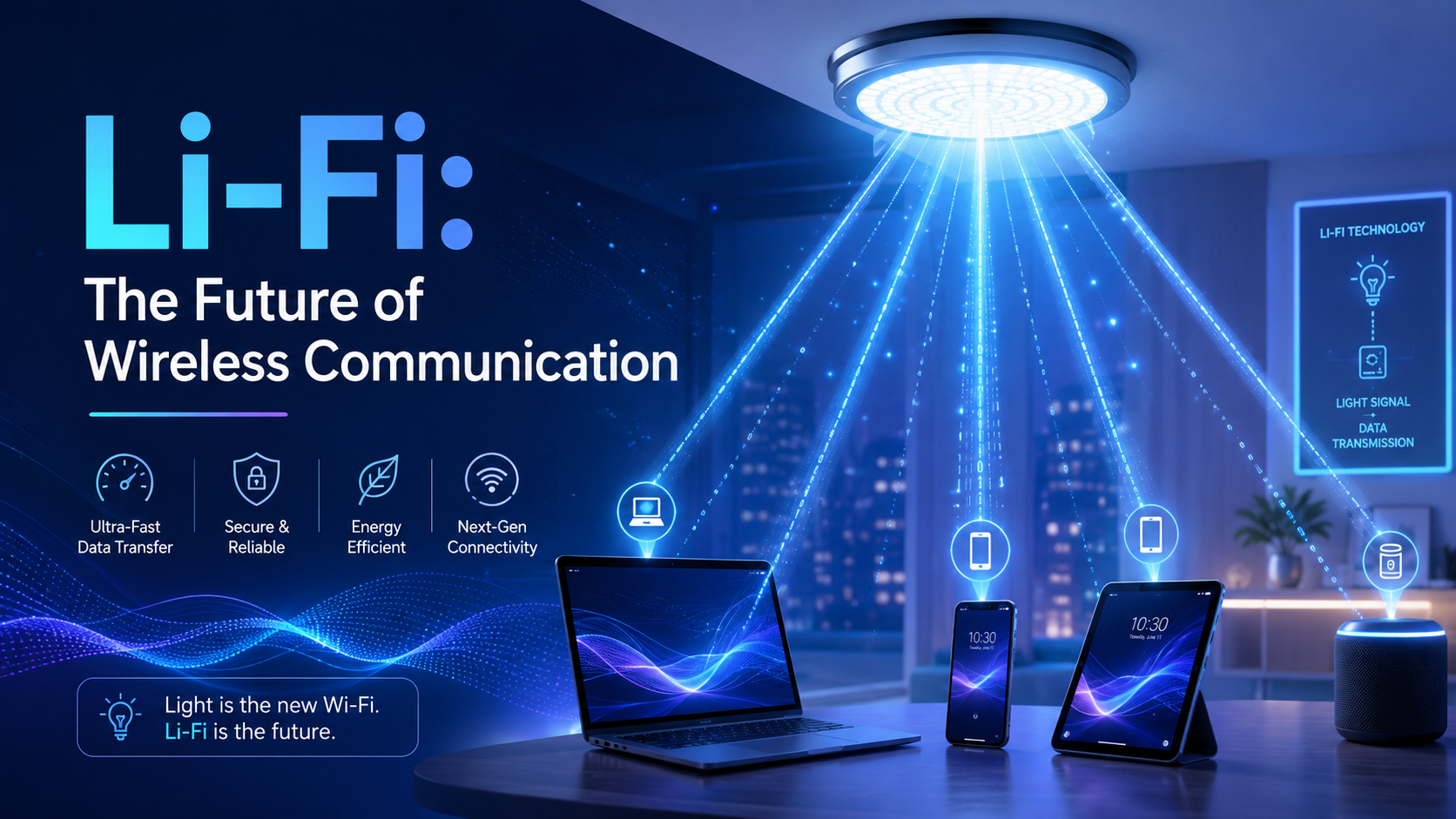
In our hyper-connected world, internet access has become as essential as electricity. Today, most devices rely on Wi-Fi, a radio-wave-based technology that is increasingly stretched thin by the sheer number of connected devices competing for the same limited radio spectrum. But what if the light bulbs in your room could also transmit internet data? This is the idea behind Li-Fi (Light Fidelity) — and it's no longer just a lab experiment. As of 2026, it has its own global wireless standard and a growing lineup of commercial hardware.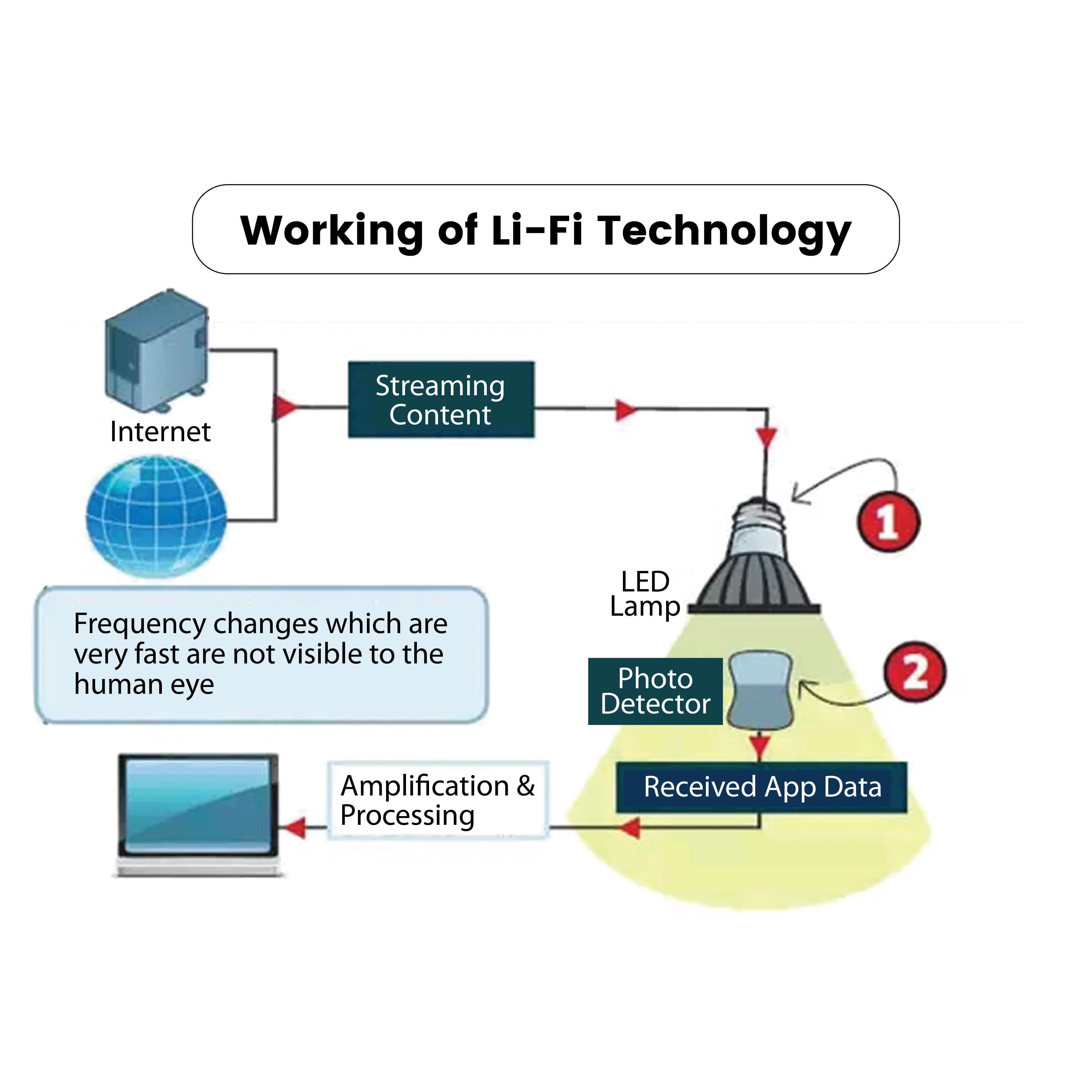
What is Li-Fi?
Li-Fi is a wireless communication technology that uses visible light from LEDs (Light-Emitting Diodes) to transmit data. Unlike Wi-Fi, which relies on radio frequencies, Li-Fi leverages the flickering of LED light — invisible to the human eye — to encode and send information at extremely high speeds.
The concept was pioneered by Professor Harald Haas, often called the "father of Li-Fi," who went on to co-found pureLiFi alongside Dr. Mostafa Afgani in 2012. What began as an academic curiosity has since matured into a technology backed by real industry infrastructure.
How Does It Work?
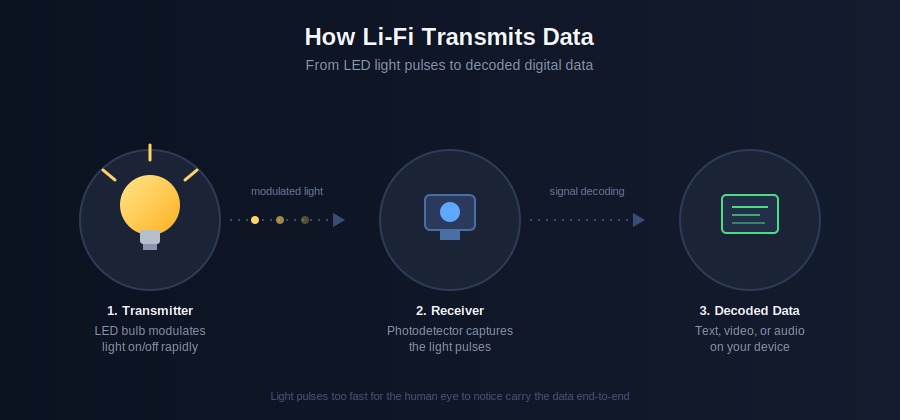
- A Li-Fi transmitter (an LED bulb or dedicated light antenna) emits modulated light signals, switching on and off at speeds far too fast for the human eye to notice.
- A Li-Fi receiver (a photodetector) in your device captures these light pulses.
- The receiver decodes the signals back into digital data — text, video, audio, or any other data stream.
A Technology With a Standard Now: IEEE 802.11bb
The single biggest development in Li-Fi's story since earlier writeups is standardization. The IEEE approved 802.11bb, a formal standard for light-based wireless communication, giving the technology a common framework that global manufacturers can build against. Before this, Li-Fi devices from different vendors had no guarantee of working together — the kind of fragmentation that keeps a technology stuck in pilot projects.
In theory, the 802.11bb standard supports throughput ranging from 10 Mb/s up to 9.6 Gb/s, though real-world speeds will vary by deployment. The standard was spearheaded by industry players including pureLiFi and Fraunhofer HHI, and it defines the physical layer specifications and system architecture needed for broader adoption.
Hardware is already catching up to the paperwork. pureLiFi's "Light Antenna ONE" is one of the first devices built to be fully compliant with 802.11bb, offering a narrow field of view and transmission rates up to roughly 1 Gbps. It's designed as a drop-in accessory that adds a Li-Fi channel to existing Wi-Fi chipsets, effectively making light-based connectivity look like just another Wi-Fi band to the device.
Looking further ahead, standards work hasn't stopped at 802.11bb. A follow-on amendment, 802.11br, is targeting completion around 2028 and aims to extend Wi-Fi operation into optical spectrum bands — both visible light and infrared — building directly on the foundation 802.11bb established, and even enabling combined optical and radio-frequency links. In other words, the industry's direction of travel isn't "Li-Fi replaces Wi-Fi" — it's Li-Fi and Wi-Fi merging into a single, spectrum-flexible standard.
Advantages of Li-Fi
- Blazing speed: Li-Fi has been demonstrated at speeds up to 224 Gbps under laboratory conditions — dramatically faster than current Wi-Fi ceilings.
- Security by physics: Since light cannot pass through walls, a Li-Fi signal is naturally confined to the room it's transmitted in, making it far harder to intercept from outside than a radio signal that leaks through walls and floors.
- Reduced spectrum congestion: By moving data traffic onto the light spectrum, Li-Fi frees up crowded radio-frequency bands for the devices that still need them.
- Energy efficiency: LED bulbs already installed for lighting can double as data transmitters, so the infrastructure cost of adding connectivity is lower than deploying a parallel network.
- Interoperability on the horizon: With 802.11bb now finalized and 802.11br in development, Li-Fi is being built to interoperate with — not fight against — the Wi-Fi ecosystem people already use.
Limitations
- Line of sight: Li-Fi requires a relatively unobstructed path between transmitter and receiver, since light doesn't bend around obstacles the way radio waves can.
- Limited range per access point: Because light can't pass through walls, buildings need multiple Li-Fi access points to achieve the kind of whole-building coverage Wi-Fi provides with fewer routers.
- Still an emerging market: Even with a ratified standard, device-level adoption is early — most smartphones and laptops don't yet ship with built-in Li-Fi receivers.
- Ambient light sensitivity: Performance can vary depending on interference from sunlight or other light sources in the room, and real-world throughput is generally well below laboratory best-case numbers.
Real-World Applications
- Healthcare: Hospitals and clinical settings, where radio-frequency interference can affect sensitive medical equipment, are a natural fit for a technology that doesn't use RF at all.
- Industrial and manufacturing environments: Factories with heavy electromagnetic interference or strict RF-shielding requirements can use Li-Fi for equipment communication without the interference issues.
- Aviation: In-flight connectivity that doesn't risk interfering with avionics systems.
- Education: Secure, high-speed classroom networks, particularly in settings where controlling exactly who can access the network matters.
- Smart homes: LED lighting fixtures that double as the household's internet infrastructure — connectivity that comes baked into a light fixture you were going to install anyway.
- Underwater communication: Radio waves struggle underwater, but light-based transmission doesn't have the same limitation, making Li-Fi a candidate for niche marine and defense applications.
Conclusion
Li-Fi has moved from an academic proof-of-concept to a technology with an actual industry standard and commercial hardware behind it. The ratification of IEEE 802.11bb — and the follow-on work already underway on 802.11br — signals that the wireless industry sees Li-Fi not as a Wi-Fi replacement, but as a complementary layer: one that adds security, reduces spectrum congestion, and turns the light fixtures already in every room into part of the network.
It likely won't replace the router on your desk anytime soon. But as LED lighting and Li-Fi-compliant chipsets become more common, the light in your room may quietly start doing double duty — illuminating your space and carrying your data at the same time.
What do you think? Would you consider a Li-Fi-enabled light bulb once compliant devices reach the consumer market? Share your thoughts in the comments below.